Boardwalk or Sand Path: Two Ways to Move Along a Beach
Boardwalk or sand path? See how height, texture and beach access shape the view, and choose the kind of coastal walk that suits the place.
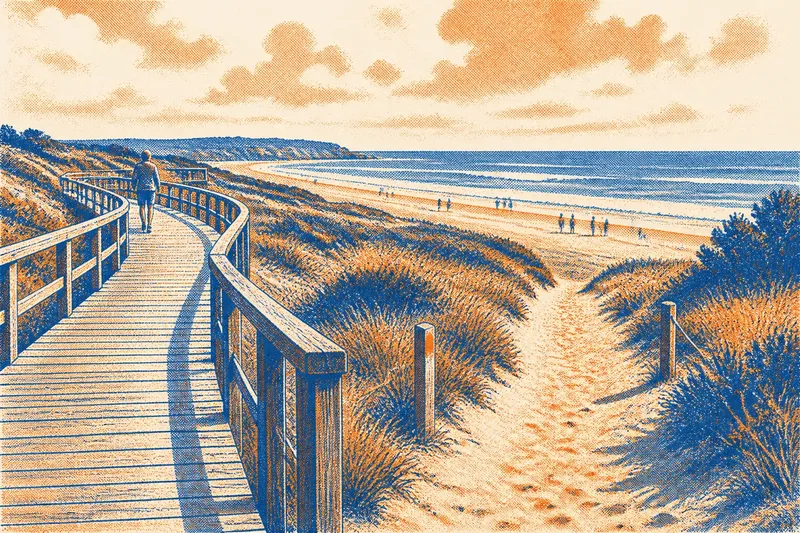
The common mistake in choosing between a boardwalk or sand path is treating one as the obvious upgrade to the other. A raised deck may offer a clean line and firm footing, but it can turn the beach into a framed scene; a path pressed into sand brings you closer to its shifting surface, while sometimes leaving you to negotiate soft spots and blown-over sections. Each route gives the shoreline a different character.
The useful question is not which is better in the abstract, but what the path lets you notice—and what it puts between you and the beach. Height, material, edge, and direction all shape that encounter. They also create distinct problems for designers and visitors, from a boardwalk that feels like a barrier to a sand track that disappears into a field of footprints.
Why can a boardwalk make the beach feel distant?
Elevation creates a clear visual separation. From a raised boardwalk, you may see over low dune plants and follow the waterline without stepping through fragile vegetation. That vantage can make the beach read as a broad composition: sea beyond, shore below, rail or deck in the foreground. The neatness is part of the appeal, but it can also make the beach feel like something viewed from a platform rather than entered.
That effect grows when the deck is wide, the railing prominent, or the path runs straight and high above the sand. A visitor’s eye meets the structure before the shore. Repeated posts or a continuous handrail can cut the view into narrow panels, especially where the route follows the water instead of approaching it.
What to try: look at the path from both directions and from the beach below. If its edge dominates, consider whether a less visually heavy railing, a lower profile where appropriate, or a turn that opens a view would soften the boundary. A boardwalk’s purpose may require a rail or a particular height; the design question is how its visible elements relate to the horizon, not how to remove them at any cost.
Why does a sand path seem to vanish?
A ground-level route often blends into its setting by design. Its colour may resemble dry beach sand, and its surface can change with wind, rain, tides, and passing feet. That closeness gives the walk a looser, more immediate feel, but it can be difficult to read where the intended path begins or ends.
Look for competing tracks, especially around beach entrances or near dunes. If many parallel footprints spread across a broad area, the route may not have a visible cue that distinguishes it from the surrounding sand. Visitors can then wander into planted or sensitive ground simply because the path’s edge is ambiguous.
What to try: assess the route at a normal walking pace, rather than only from a map or an elevated viewpoint. A gently legible line might come from the path’s curve, a change in surface texture, or an existing boundary that directs attention without turning the route into a fenced corridor. The aim is to help people recognise the intended passage while retaining the open, ground-level feel.
What happens when the surface feels wrong underfoot?
A boardwalk can feel reassuringly even until its joints, boards, or transitions interrupt the stride. A sand path can feel pleasantly yielding until loose, steep, or uneven sections make walking tiring. These are different kinds of friction: one comes from the construction and its connections, the other from a surface that moves and settles.
For a boardwalk, notice where the deck meets ramps, landings, or the beach. A sharp visual or physical transition can make the route feel abrupt, even when the main stretch is smooth. For sand, pay attention to where people shorten their steps, veer away, or bunch up to avoid a soft patch. Those small behaviours reveal more than a neat line on a plan.
What to try: trace the route as a sequence of moments, not a single material choice. Consider where a firm surface should begin and end, whether a transition looks inviting, and whether the path gives enough room for people to pass without stepping off it. Suitability depends on the place, the intended use, accessibility needs, and applicable design requirements; check relevant local guidance and manufacturer instructions where they apply.
How can a path frame the view without taking it over?
A boardwalk frames through elevation and geometry. Straight runs can direct the eye towards a headland, an opening in the dunes, or the meeting of sea and sky. A bend can reveal the shore gradually, while a landing can create a pause. But a strong axis can also make the beach feel staged, as though the visitor has been given one authorised view.
A sand path usually frames less directly. Its curves may follow a dune edge or an existing line in the landscape, letting the view shift with each step. If the route is too faint, though, that informal quality can become uncertainty. If it is too broad or heavily marked, it may lose the sense of a track shaped by the place.
Say a small coastal reserve has a sandy approach that opens onto a wide beach, and visitors keep walking straight across a planted dune shoulder. Imagine the path is given a gentle bend along the already bare edge, with a visible change in texture at the entrance. The expected result is a route that reads more clearly from the approach while allowing the sea view to unfold rather than appearing as a framed picture from the first step.
What do people ask about boardwalks and sand paths?
Which path gives a closer beach experience?
A sand path keeps the walker at ground level, so the surface and the edge of the beach feel more immediate. A boardwalk can still bring someone close to the shore, but its raised deck and boundaries make the relationship feel more observed and composed.
Does a boardwalk always offer a better view?
Not necessarily. Height can clear low obstacles, but railings, structures, or a route running parallel to the water may interrupt the view. A low, winding sand path can reveal the shoreline gradually and keep attention on changing details at ground level.
Why do sand paths become hard to follow?
Wind, foot traffic, and shifting sand can blur their edges or create several competing tracks. A distinct curve, a subtle surface change, or a clear entrance can help the intended line remain readable without making it feel like a paved promenade.
Can a boardwalk and a sand path work together?
They can serve different parts of the same coastal setting: a firm raised section may cross sensitive ground, while a ground-level track continues where the beach allows closer contact. The transition between them matters, because an abrupt change can make the route feel discontinuous.
When does a boardwalk become too prominent?
A structure begins to dominate when its proportions, colour, or repeated details draw the eye more strongly than the shoreline. Dark rails against pale sand, a broad deck across a narrow dune corridor, or a long, straight line can all make the path the main subject. None is automatically wrong; each changes the balance between movement and scenery.
What to try: step back and view the boardwalk from the beach, the entrance, and any nearby lookout. Consider how its outline sits against the water and sky, and whether its materials echo the coastal setting without pretending to disappear. A restrained finish can reduce visual weight, but camouflage is not always the goal: people still need to recognise the route and understand its boundaries.
What is not worth the effort is trying to make every boardwalk invisible or every sand path perfectly crisp. Coastal conditions continually alter surfaces, and an overly polished appearance can feel at odds with a living shoreline. Better to aim for a path whose presence is clear and proportionate.
How should you read the route before choosing its character?
Start by noticing what the existing landscape already asks of a walker. Is the ground firm or easily disturbed? Does the view arrive all at once or open gradually? Are people lingering, crossing, or simply passing through? These observations point towards the kind of path that may fit, without prescribing a single route for every beach.
Then compare the experience at the edges, not just in the centre. A boardwalk’s approach and exit can feel more consequential than its long middle stretch. A sand path’s entrance and its relationship to nearby tracks can determine whether it feels natural or confusing. Consider how the route appears to someone arriving from land, someone standing on the beach, and someone looking back from the waterline.
Boardwalk or sand path is ultimately a choice about how a coastal place invites movement. One lifts the walk above the ground and often gives it a defined line; the other keeps the walker close to a surface that shifts and blends. The most fitting route lets people move through the landscape while leaving the shore’s own forms—not the path alone—to hold their attention.